
From Semantic Layers to Ontologies: Why Your AI Agents Need More Than Metrics
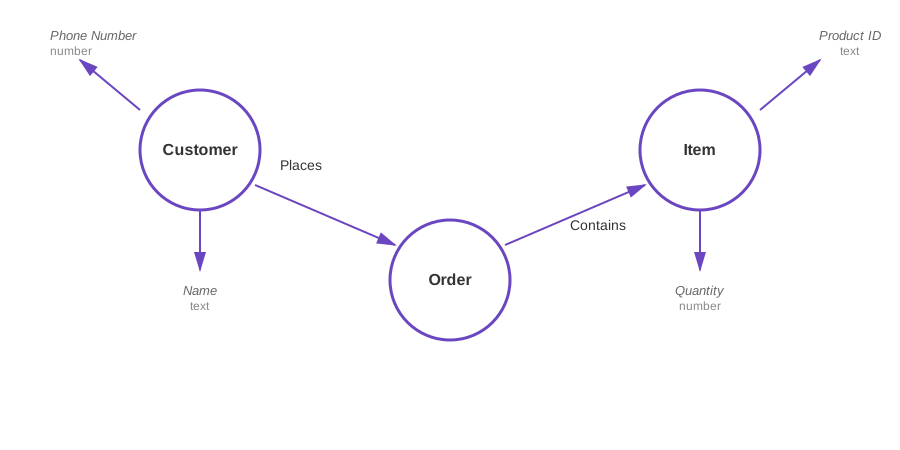
Executive Summary:
While semantic layers revolutionized BI, operational AI demands ontologies that model not just metrics but objects, relationships, and actions. Learn why the world's most successful data platforms use this approach and how to evolve your semantic layer into an operational ontology.
From Semantic Layers to Ontologies: Why Your AI Agents Need More Than Metrics
The Hidden Architecture Behind Operational AI
There's a pattern emerging among companies that successfully deploy AI at scale. While most organizations perfect their dashboards and metrics, the leaders are building something fundamentally different: operational ontologies that don't just measure the business - they run it.
This isn't about having better algorithms or bigger models. It's about giving AI the context to understand not just what your metrics mean, but how your business actually operates.
If you're running a semantic layer today (dbt, Cube, AtScale), you're ahead of 80% of the market. But as AI agents evolve from chatbots to operational systems, semantic layers alone won't cut it. Here's why - and what to do about it.
The Semantic Layer Revolution: How We Got Here
Semantic layers solved a critical problem. Before tools like dbt's semantic layer emerged, every dashboard had its own definition of "revenue." Finance counted closed deals. Sales included pipeline. Marketing added trials. The Monday meeting was chaos - five departments, five numbers, all "correct."
Semantic layers fixed this by creating a single source of truth for metrics:
Unified definitions: "Revenue" means one thing everywhere
Reusable logic: Calculate once, use everywhere
Self-service analytics: Business users query without SQL
Governance: IT controls definitions, users consume safely
For business intelligence, this was revolutionary. Companies like Airbnb (Minerva), Transform (now part of dbt), and Cube turned metrics chaos into metrics clarity. Suddenly, everyone was speaking the same language.
But here's what semantic layers can't do: approve an invoice, trigger a maintenance workflow, or escalate a customer complaint. They can tell you about your business. They can't run it.
The Ontology: Your Business as an Operational Model
An ontology extends beyond metrics to model your entire business operation. Think of it as the difference between a scoreboard and a playbook - one tells you the score, the other enables you to change it.
Core Components of an Operational Ontology
1. Objects (Not Just Tables)
- Semantic layer: "customer" table with attributes
- Ontology: Customer object that can perform actions, has relationships, follows rules
2. Relationships (Not Just Joins)
- Semantic layer: Foreign keys linking tables
- Ontology: Semantic relationships with business meaning
Customer OWNS Equipment
Equipment REQUIRES Maintenance
Maintenance BLOCKS Production
Production AFFECTS Revenue
3. Actions (Not Just Queries)
- Semantic layer: SELECT, GROUP BY, AGGREGATE
- Ontology: Business operations with rules and side effects
Approve_Invoice (requires: authority level, triggers: payment workflow)
Schedule_Maintenance (constraints: production windows, dependencies: parts availability)
Escalate_Issue (rules: severity matrix, notifications: stakeholder list)
4. Constraints and Rules
- Semantic layer: Data types and basic validation
- Ontology: Business rules and operational constraints
"Only managers Level 3+ can approve invoices >€50K"
"Critical equipment maintenance windows must be <2 hours"
"Customer classification changes trigger contract review"
Why This Matters Now: The AI Agent Revolution
In 2024, we built chatbots. In 2025, we're building agents. The difference? Agents take action.
Consider this scenario: Your AI agent encounters an overdue invoice of €75K from a strategic customer.
What a semantic layer tells the agent:
- Invoice amount: €75,000
- Days overdue: 47
- Customer tier: Strategic
- Historical payment delay: 32 days average
What an ontology enables the agent to do:
- Understand this requires escalation (amount + customer tier)
- Identify who can approve (Level 4 managers in Finance)
- Check credit hold implications (customer has 3 open orders)
- Execute the approval workflow (notify, document, update systems)
- Monitor downstream effects (release held shipments upon approval)
This is the difference between AI that informs and AI that performs.
The Investment Case: Why This Pays Off
Building an ontology requires more effort than implementing a semantic layer, but the returns are compelling:
Quantifiable benefits we've observed:
- 72% reduction in integration time for new use cases
- 59% decrease in operational errors
- ROI typically achieved within 9-12 months
Strategic advantages:
- Composability: Build once, reuse everywhere
- Consistency: One model drives all decisions
- Agility: Change business rules without changing code
- Compliance: Auditable, governed operations
Common Pitfalls and How to Avoid Them
1. Trying to model everything at once
- Start small, prove value, then expand
- One successful domain beats five failed attempts
2. Over-engineering the ontology
- Begin with simple relationships
- Add complexity only when needed
- Practical beats perfect
3. Ignoring organizational readiness
- Ensure stakeholder alignment early
- Invest in change management
- Celebrate quick wins
4. Underestimating governance needs
- Build access controls from day one
- Document everything
- Plan for compliance requirements
The companies winning with AI aren't necessarily those with the biggest models or most data. They're the ones whose AI understands not just their metrics, but their operations.
Semantic layers gave us consistent metrics. Ontologies give us operational AI.
About Pyne: We're a Danish boutique consultancy that helps mid-market companies build operational data and AI systems to improve their bottom line. We've guided 40+ organizations through the journey from data to decision apps, focusing on practical ROI and sustainable implementations.